
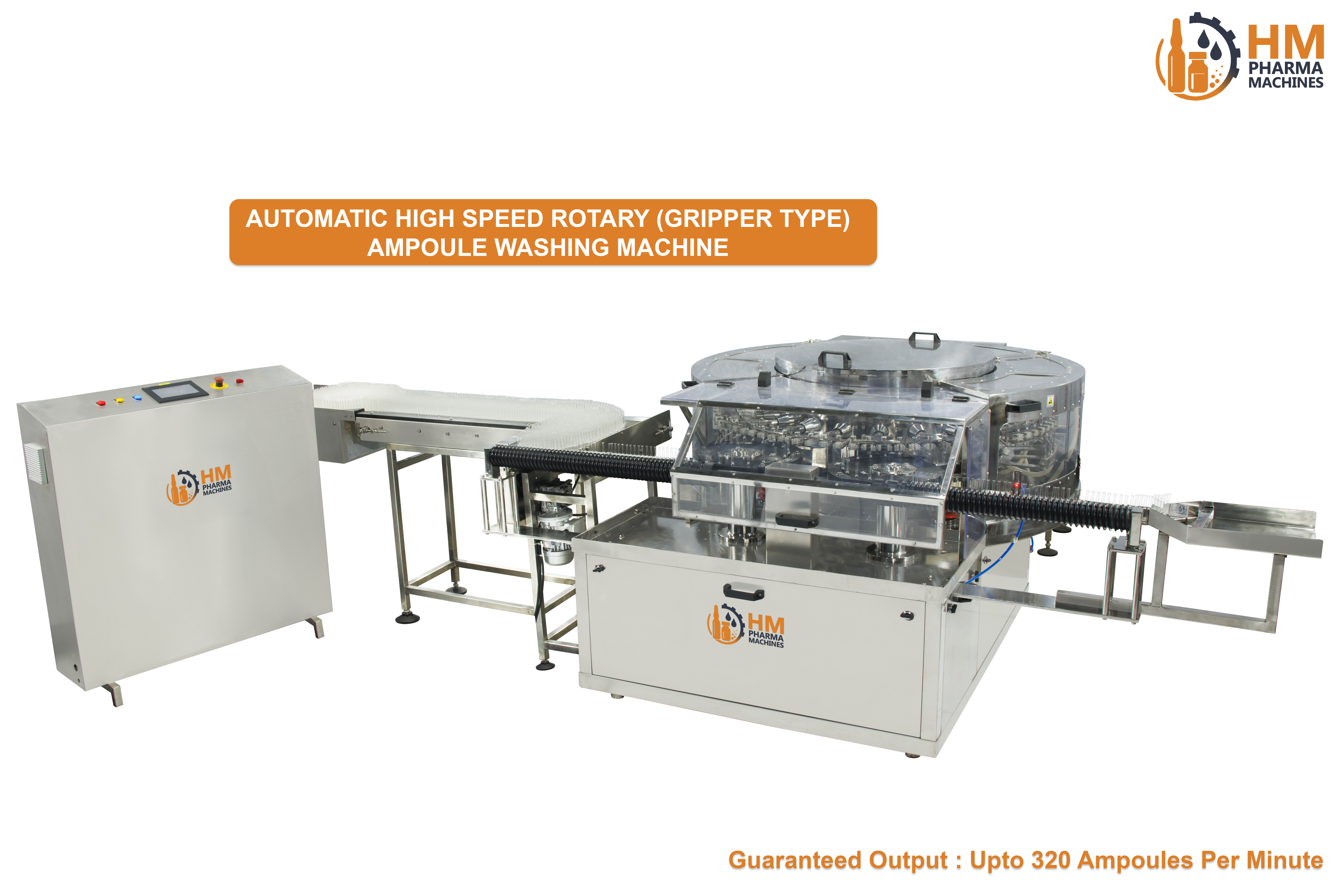
Automatic High-Speed Ampoule Washing Platform
Mesh-conveyor infeed, feedworm spacing, starwheel transfer and rotary gripper handling support a defined internal and external ampoule washing cycle.
Rotary gripper ampoule washing machines for approved 1 mL to 20 mL ampoules, available in 120, 180, 240 and 320 APM output models with controlled RC water, PW, WFI and compressed-air stages.
1-20 mL • 120-320 APMMachine overview
H M Pharma Machines manufactures the Rotary Gripper Ampoule Washing Machine in Ahmedabad, Gujarat, India for sterile and injectable pharmaceutical production applications.
Ampoules transfer from the mesh conveyor through an infeed feedworm and starwheel before entering the rotary gripper washing section. The platform is offered in four output configurations from 120 to 320 ampoules per minute.
Six internal stages follow the sequence RC water, air, PW, air, WFI and air. Two external stages apply RC water followed by air. Final model selection and change parts are confirmed from the approved ampoule sample or drawing, wash process and line layout.
Main machine
Review the model range below or open the detailed product page for complete specifications, controls, utilities and documentation.

Mesh-conveyor infeed, feedworm spacing, starwheel transfer and rotary gripper handling support a defined internal and external ampoule washing cycle.
Available outputs
Choose the initial model according to the required ampoules-per-minute output. Final rated performance is confirmed against the approved ampoule format.
For approved applications requiring a rated output of 120 ampoules per minute.
For approved applications requiring a rated output of 180 ampoules per minute.
For approved applications requiring a rated output of 240 ampoules per minute.
For approved applications requiring a rated output of 320 ampoules per minute.
Defined wash cycle
Each gripped ampoule passes through six internal water and air stages, followed by the defined external washing arrangement.
Initial internal wash using recycled water.
Air stage after the RC-water wash.
Internal wash using Purified Water.
Air stage after the PW wash.
Final water stage using Water for Injection.
Final internal air stage.
RC water is applied to the ampoule outer surface.
An air stage follows the external RC-water wash.
Technical summary
These are the main platform details. The approved quotation and machine datasheet confirm the final project scope.
| Ampoule range | 1 mL to 20 mL, subject to approved ampoule configuration |
|---|---|
| Output models | 120, 180, 240 and 320 APM |
| Infeed handling | Mesh conveyor → infeed feedworm → infeed starwheel → rotary gripper machine |
| Internal stages | 6: RC water → air → PW → air → WFI → air |
| External stages | 2: RC water → air |
| Process tanks | 3 tanks of 40 L each for RC water, PW and WFI |
| Process pumps | 3 |
| Process protection | Automatic level control, HMI pressure monitoring, alarms and automatic-stop interlocks |
| Documents | DQ, IQ, OQ, PQ, FAT, SAT, manuals, certificates, wiring diagram and machine layout as defined in the approved scope |
Selection guide
Provide these inputs during the first technical discussion.
Share all ampoule sizes, drawings or physical samples required on the machine.
Specify the target ampoules per minute and connected filling-line capacity.
Confirm the approved RC-water, PW, WFI and compressed-air process.
Share sterilizing-tunnel, filling-machine and room-layout interface details.
Related ampoule equipment
Explore related filling, sealing, labeling and washing-machine categories.
Frequently asked questions
The rotary gripper ampoule washing machine is offered for approved 1 mL to 20 mL ampoule configurations.
Four output models are available: 120, 180, 240 and 320 APM, where APM means ampoules per minute.
The six internal stages are RC water, air, PW, air, WFI and air. Two external stages apply RC water followed by air.
Ampoules move from the mesh conveyor through the infeed feedworm and infeed starwheel before entering the rotary gripper washing machine.
Share ampoule sizes or samples, required APM output, approved wash sequence, utility details and downstream line-interface requirements.
Send ampoule samples, required APM, wash process and line-layout details for technical review.